

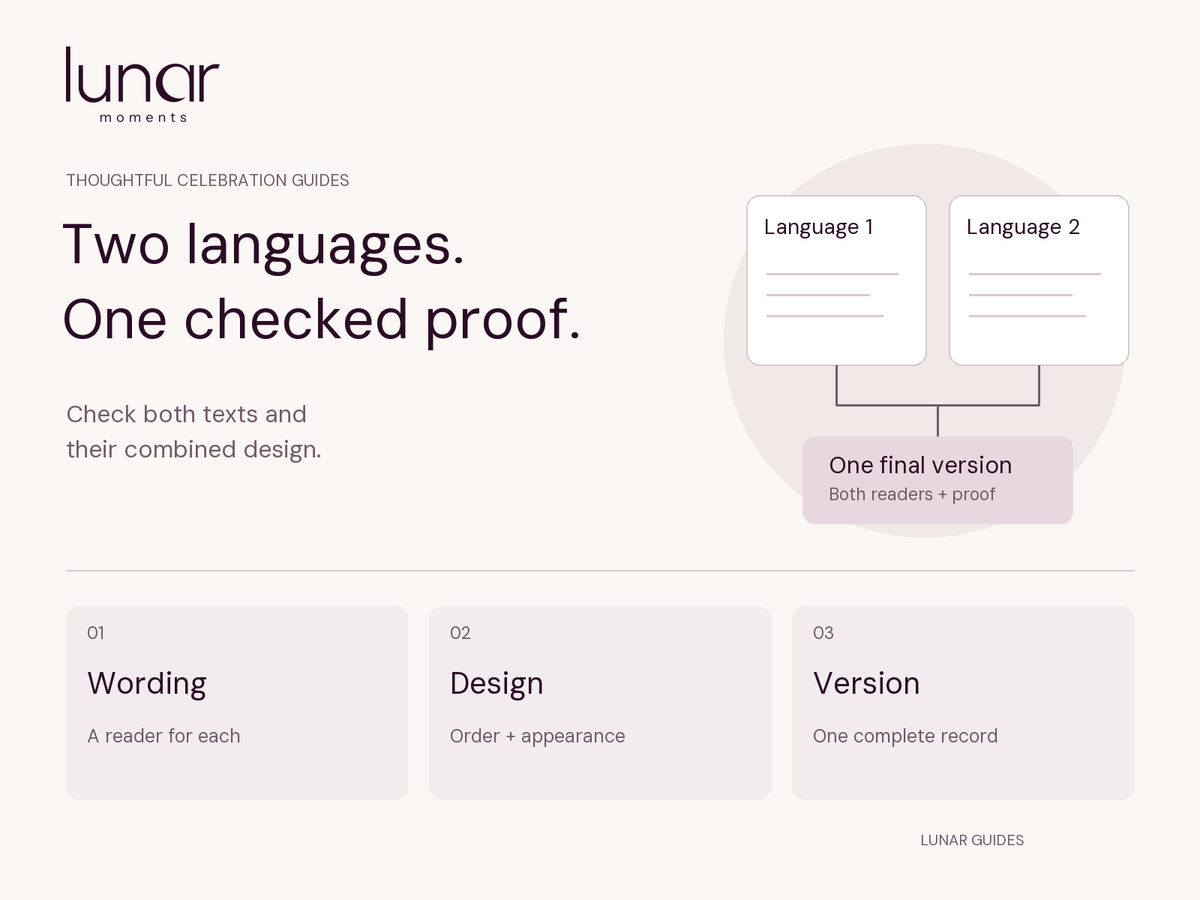
For two languages on a personalised balloon, supply the exact wording in both scripts, name someone who can check each one, and ask the supplier whether the requested text and arrangement can be produced. Approve both the words and their appearance in the proposed design. A general request for personalisation does not establish a translation service or support for every script or font.
This worksheet is for a Dubai gift or business display where the message has already been chosen. For help choosing the message itself, use the personalised bubble wording checklist. Here, the job is to carry two checked text versions through one proof and approval process.
Give each supplied text its own label
Create a wording block labelled “Language A” and another labelled “Language B”. Name the language beside each block and keep all design instructions outside the text. Supply the wording directly, rather than asking the designer to extract it from several photographs.
Have a reader of each language check the actual phrase, name, punctuation and numbers you intend to use. If a person’s name is written differently in the two scripts, ask the relevant reader to confirm the preferred version. Do not assume an automatically generated translation or transliteration is the recipient’s preferred wording.
The Personalised Bubble Balloons listing describes personalised designs with custom names, ages and messages. Ask Lunar Moments what it can produce for your two supplied texts, including the script, requested styling and amount of wording. Keep any translation or wording-checking arrangement explicit.
Request a proof that shows the relationship between the lines
Explain which message should appear first and whether one language should be more prominent or both should have equal emphasis. Describe your preferred line order without treating it as a confirmed layout. Ask what arrangement the team proposes for the actual balloon design.
For text that reads in different directions, have each language reader check the proposed proof itself. Ask them to confirm how the words, punctuation, names and numbers appear together. Checking the source wording alone does not answer whether the displayed arrangement is the one you wanted.
Ask how a proof can be supplied and reviewed. Do not assume a particular digital proof, font, character allowance or revision service is included simply because an inspiration photograph shows something similar.
Copy this two-language proof record
Complete both language columns before giving one final instruction. Leave the production-capability answers for the supplier.
| Check | Language A | Language B |
|---|---|---|
| Supplied wording | Paste the complete checked text. | Paste the complete checked text. |
| Wording reader | Name the person checking this language. | Name the person checking this language. |
| Names and numbers | Confirm the exact version wanted. | Confirm the exact version wanted. |
| Proposed order | Record the intended position or emphasis. | Record the intended position or emphasis. |
| Supplier response | Record what can be produced and any open question. | Record what can be produced and any open question. |
| Proof checked | Reader, proof reference and requested correction, if any. | Reader, proof reference and requested correction, if any. |
Approve the combined design after both readers respond
Choose one coordinator to collect the two responses. That person should distinguish “wording checked” from “combined proof approved”. If one reader has replied and the other has not, record the outstanding check rather than sending a general “looks good”.
As an illustrative example, one reader might approve a name while the second asks to change a number. Send the complete revised wording blocks, identify the changed detail and ask for the combined design to be checked again as appropriate. Do not forward a corrected fragment without explaining which version it replaces.
If the supplier suggests shortening one line or changing the order, return that suggestion to the person responsible for the affected text. Once resolved, keep one complete wording version and the corresponding proof reference together. This is a suggested coordination method, not a promise of a particular production or revision process.
A concise enquiry to adapt
We would like to discuss a personalised balloon for [occasion and date] in [Dubai area]. The two supplied wording blocks are labelled Language A and Language B. Our preferred order is [description]. The text has been checked by [readers], and final combined approval will come from [coordinator]. Please confirm which scripts and arrangement you can produce, how the proposed design can be checked, and the agreed scope and charges.
Send Lunar Moments the two labelled wording blocks. Agree the design and full quoted scope, with date capacity and booking terms confirmed separately.
Two-language wording questions
Does personalised wording include translation?
The listing does not establish a translation service. Supply wording checked by an appropriate reader and ask the team what it can produce for the requested languages and design.
Should each language be checked separately or together?
Do both: have each reader check their supplied wording, then review how both texts appear in the combined proof, including line order, names, numbers and punctuation.
What if one wording block changes after approval?
Send the complete revised blocks with a new version label, identify the change and ask how it affects the proposed design. Keep the corresponding proof and both readers’ responses together.


